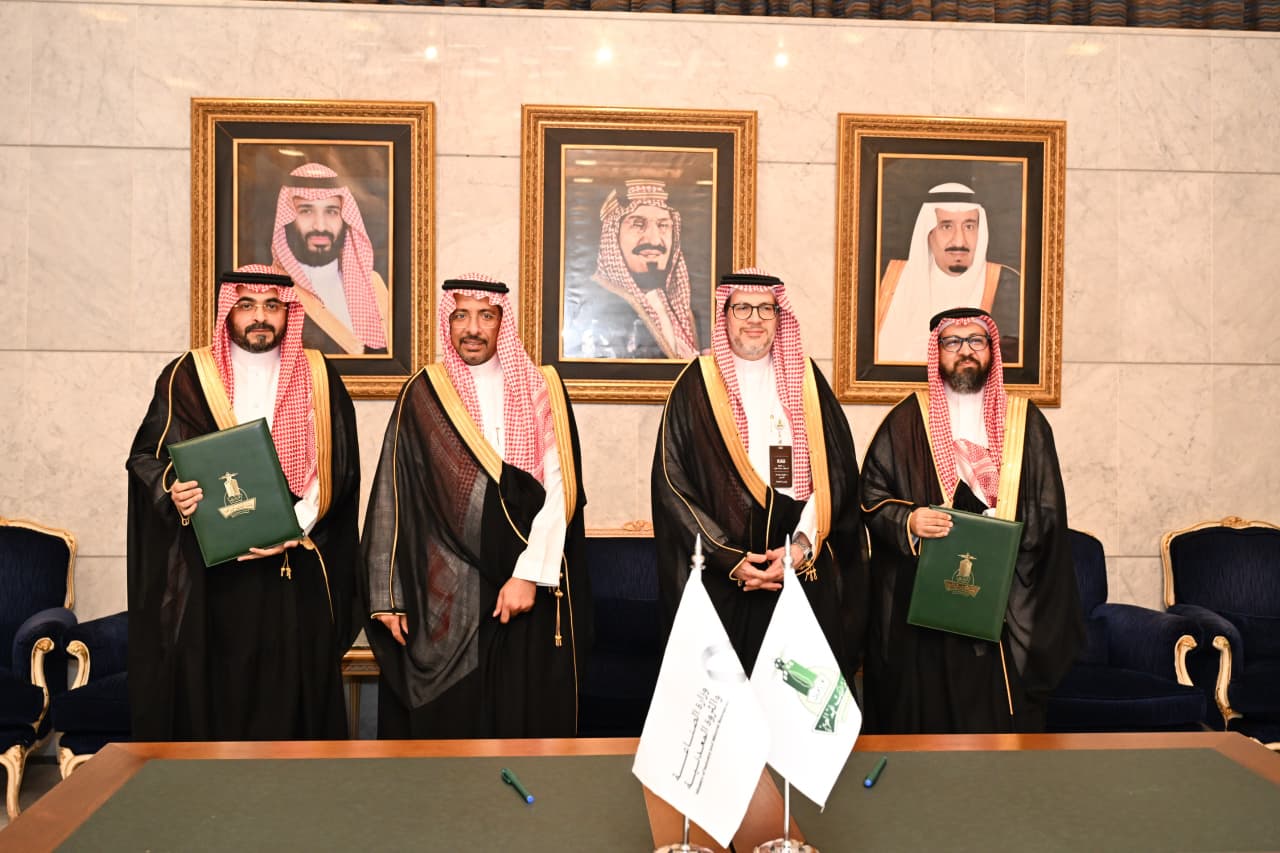
The Ministry of Industry and Mineral Resources has signed a memorandum of understanding with King Abdulaziz University to strengthen cooperation in developing academic and training programs, aligning educational outcomes with labor market requirements, and supporting innovation and industrial digital transformation. The signing took place in the presence of His Excellency the Minister of Industry and Mineral Resources, Mr. Bandar bin Ibrahim Alkhorayef, and the President of King Abdulaziz University, Dr. Tareef bin Youssef Alaama, on Tuesday, 21 April 2026, at the King Faisal Conference Center.
Representing the ministry at the signing was Eng. Faris Al-Saqabi, Deputy Minister for Human Capability Development, while Dr. Mohammed bin Reda Kabli, Vice President for Educational Affairs, represented King Abdulaziz University. Through the MoU, both parties aim to sustain the institutional impact of their joint cooperation and strengthen integration between the academic, industrial, and mining sectors in support of national development goals.
The MoU seeks to develop academic and training programs linked to sector needs while ensuring that educational outcomes align with actual labor market requirements. It also aims to prepare qualified national talent to support the growth of the industrial and mining sectors, activate the university’s role in advancing applied scientific research, and build specialized capabilities that contribute to the Kingdom’s economic transformation.
Several high-impact areas form the focus of the agreement, most notably the introduction of academic programs in Aeronautical Engineering and advanced industrial specializations. The partnership also includes the design and implementation of practical and cooperative training programs for students within ministry sectors, particularly in industrial data analysis and information management. In addition, ministry experts will deliver specialized lectures and workshops at the university to strengthen students’ applied skills.
Areas of cooperation further include establishing an academic-applied laboratory within the university, enabling students and faculty members to work with real industrial data. Graduation projects and postgraduate research will also be linked to real sector challenges. In addition, both parties will work on joint applied research projects involving factories and investors to develop market-ready industrial products