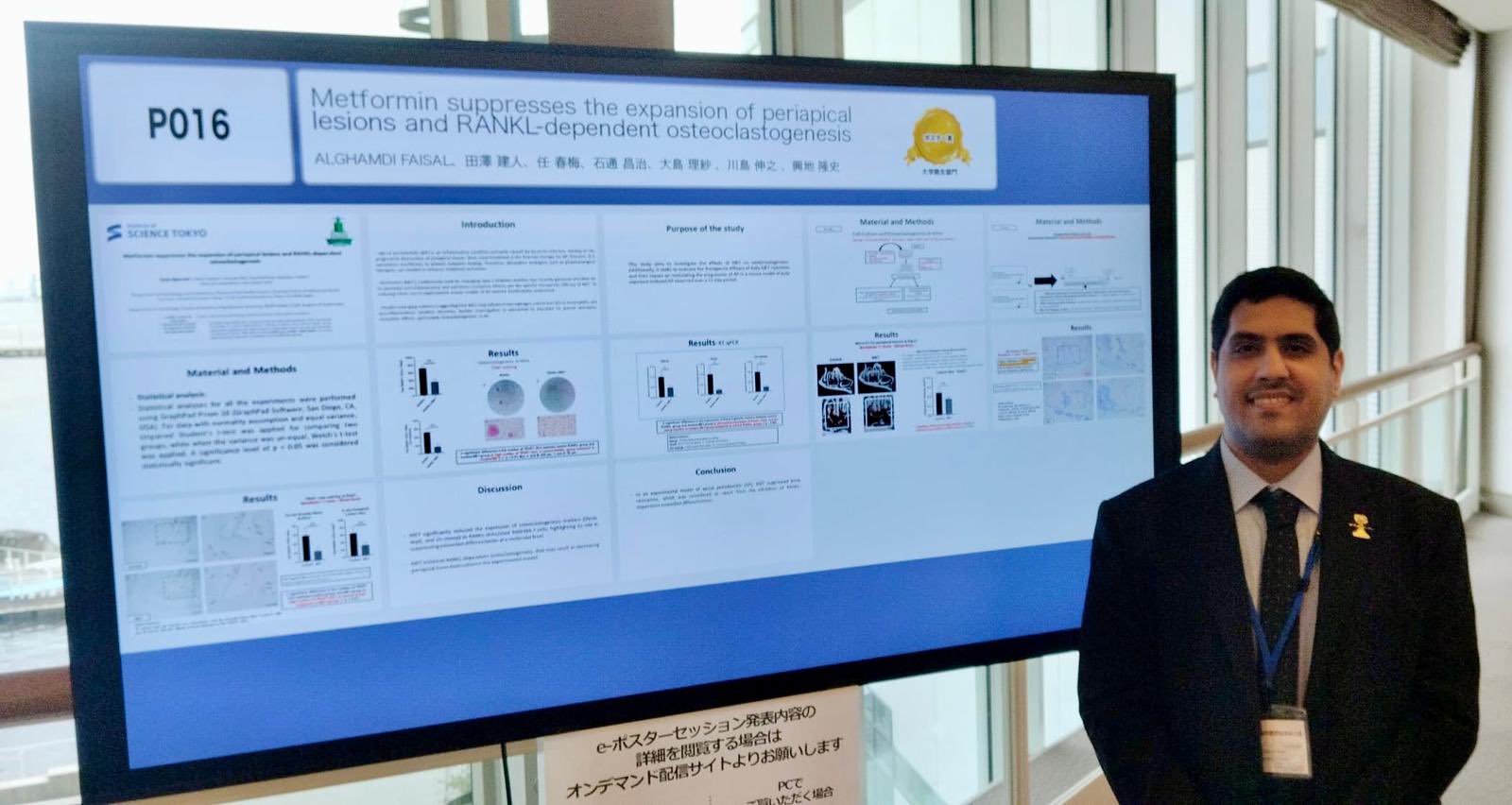
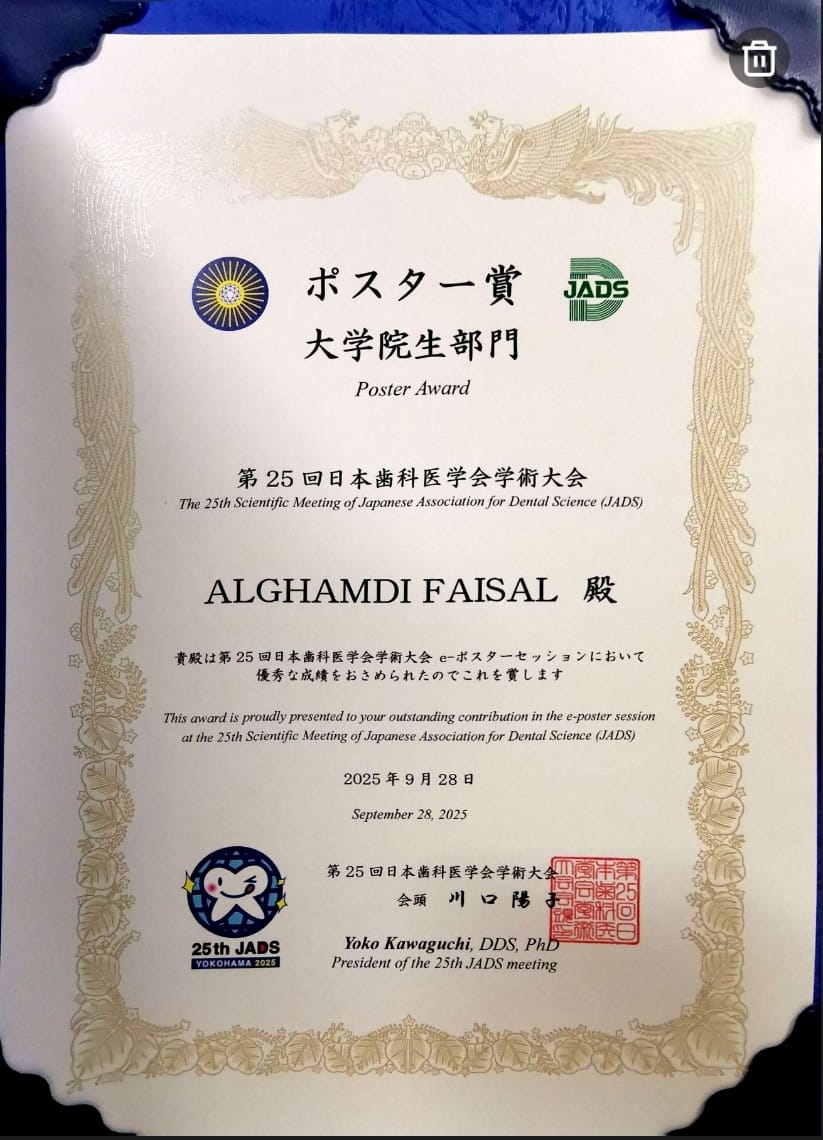
Saudi researcher Faisal bin Turki Al-Ghamdi, a King Abdulaziz University-sponsored
PhD candidate, has won the Best Graduate Student Research Award at the 25th
Scientific Meeting of the Japanese Association for Dental Science (JADS 2025), held
in Yokohama, Japan. His research was selected from among nearly 250 submissions
presented by universities and research institutions from around the world.
Al-Ghamdi, a PhD candidate at the Institute of Science Tokyo, formerly Tokyo
Medical and Dental University, received the award for his specialized research in
endodontics, the dental specialty concerned with root canal treatment. His study
explored the use of metformin to reduce jawbone resorption and accelerate the
healing of lesions around dental roots.
The Embassy of the Kingdom of Saudi Arabia in Japan celebrated the distinction
achieved by Dr. Faisal bin Turki Al-Ghamdi following his recognition at JADS 2025 in
Yokohama. Saudi Ambassador Dr. Ghazi Binzagr received Dr. Al-Ghamdi to
congratulate him on this achievement. The embassy also published a series of posts
on its official account highlighting his success and reaffirming the Kingdom’s support
for its outstanding talents abroad.
The study’s findings showed that metformin can help regulate the body’s immune
response and inhibit osteoclasts, the cells responsible for bone resorption. This may
help reduce jawbone resorption caused by acute inflammation around dental roots.
The approach opens new horizons for supportive localized therapies, paving the way
for future clinical use in dental clinics during endodontic treatment or in the
management of dental abscesses, following successful laboratory experiments in
mice using intraperitoneal injection, with the next stage focused on developing the
therapy for localized dental application.
Dr. Faisal Al-Ghamdi explained that the study focused on the RANKL pathway, which
is responsible for activating bone resorption. He emphasized that the scientific value
of the research lies in shifting the focus from merely fighting bacteria to controlling
the body’s inflammatory response. This application could contribute to the
development of intraperitoneal injections or localized medications that can more
easily reach root canals or be placed inside the root canal to accelerate healing.
Such an approach could reduce jawbone resorption, minimize the need for complex
surgical interventions or tooth extraction, and help preserve bone integrity from
resorption caused by deep dental caries.
Al-Ghamdi stressed the importance of recognizing that chronic tooth pain may
conceal underlying bone inflammation that requires early intervention. He warned
that the disappearance of pain does not necessarily mean that the inflammation has
healed; rather, it may indicate that bone resorption is continuing silently. This makes
regular radiographic follow-up essential for maintaining overall health.
Al-Ghamdi is a scholarship student from the Faculty of Dentistry at King Abdulaziz
University. He is currently pursuing a PhD in Dental Sciences with advanced clinical
training in endodontics in Japan. The scientific meeting, held at Pacifico Yokohama,
is considered one of the leading scientific forums bringing together top researchers to
develop innovative clinical treatment solutions.